For Collectors
Know your player's entire card career
From the prospect cards printed before he ever debuted to the tribute sets still printing decades after he retired. Phorager is built for the fan who picked a player and wants to understand everything that exists with his name on it.
Why this is hard
One player is never one card
Modern baseball cards are an enormous, tangled ecosystem. A dozen manufacturers, hundreds of sets a year, and parallels stacked on parallels — every one of them numbered, and none of them numbered against each other.
So the collector who loves one player has no way to see what he actually owns a piece of. Not what a single set printed. What exists.
Phorager was built to answer one question properly: what does my player's entire card career look like?
-
The serial number lies to you
A /100 tells you how many of that one design were printed. It says nothing about the thirty-nine other /100 designs of the same player sitting in the same market.
-
The catalog outlives the career
Prospect sets print before the debut. Tribute sets print for decades after the last game. The playing years are often the smallest part of the catalog.
-
Nothing connects cards to baseball
Card databases know cards. Stats sites know careers. Neither can tell you which card came from the season he actually won something.
Pre-rookie to post-tribute
A card career is longer than a playing career
Your favorite player's catalog starts before he debuts and keeps growing decades after he retires. Phorager holds all four phases in one place, so you can see the whole arc instead of the slice one set happens to cover.
Before he plays a game
Prospect sets start printing the moment a teenager signs. Years of numbered cards can already exist before a debut — none of them tagged RC.
The year everyone stops at
The RC year is where most price guides begin and end. It is one season out of a catalog that usually spans decades.
Season after season
Every year he plays, every brand prints him again — base, insert, parallel, autograph, memorabilia — across a whole range of serial tiers.
Long after the last pitch
Heritage, tribute, and archive sets keep printing for decades. For players who retired before serial numbering existed, this is nearly the whole catalog.
Phorager tracks all four phases for every player in the catalog — see the findings on Research.
In the app
Built the way a collector thinks
You start with a player you care about, not a set someone else assembled. Everything below follows from that.
Follow the lineage down to the card
Phorager is built on one path. Start at a player or a team, and every step narrows the catalog until a single card is left — and you can always see where you are on it.
- Player / Team
- Rarity
- Year
- Brands & Sets
- Card
Rarity-first is the default. A year-first path — Year → Rarity → Brands & Sets → Card — is coming, for when you already know the season you're after.
- Every step is a real, clickable breadcrumb, so you can jump back up the lineage without starting over.
- Begin at a team instead of a player and the same path applies — rarity, then seasons, then the men who wore it.
- Chasing only autographs, or only memorabilia? Flip one filter and the whole lineage re-filters beneath you.
- One search box for players, teams, and sets — no picking a mode before you know what you're looking for.
The order matters. Leading with rarity means you see how deep a player’s catalog actually goes before you commit to a year or a brand — so you’re choosing from what exists, rather than from whatever one set happened to print.
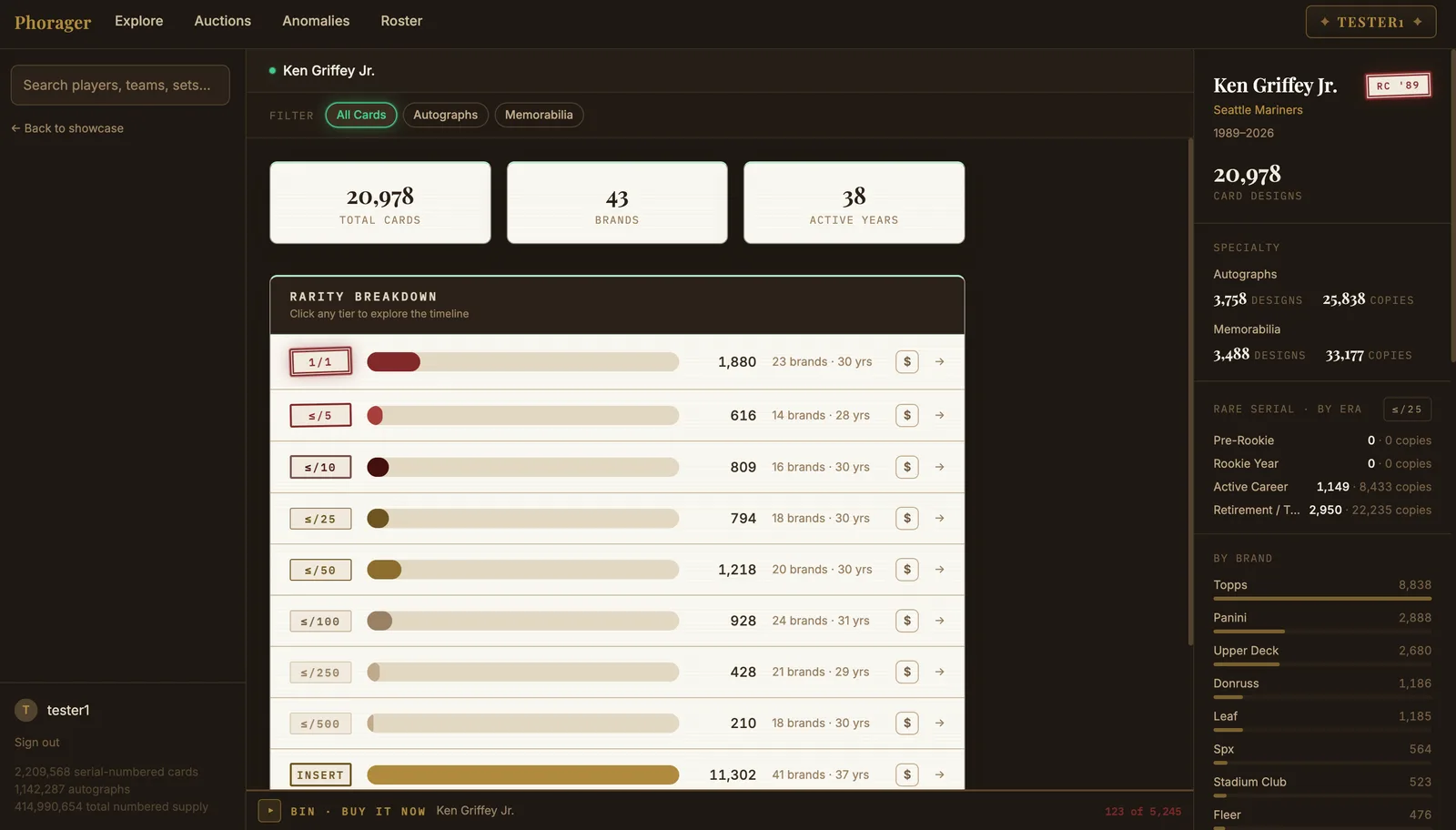
The card from the season you remember
Every year of his catalog sits right next to what he actually did on the field that season — so you can chase the card from the year that mattered to you.
- His real season line on every row — AVG and HR for hitters, ERA, wins, and strikeouts for pitchers.
- The MVP year, the ring, the All-Star nod, the Cy Young — each badged on the season it happened.
- Gold markers on any year he finished top-100 in a stat, so the special seasons stand out before you read a number.
- Card counts, rarity, and the brands that printed him, year by year alongside all of it.
- Rookie year is flagged, and the tribute era printed after he retired is split out from the years he played.
This is the part you can’t get anywhere else. Card databases know cards; stats sites know careers. Putting them on one row is what turns “I want a Judge card” into “I want a card from 2022” — the year he hit 62. You collect the player because of what he did. The catalog should be organised the same way.
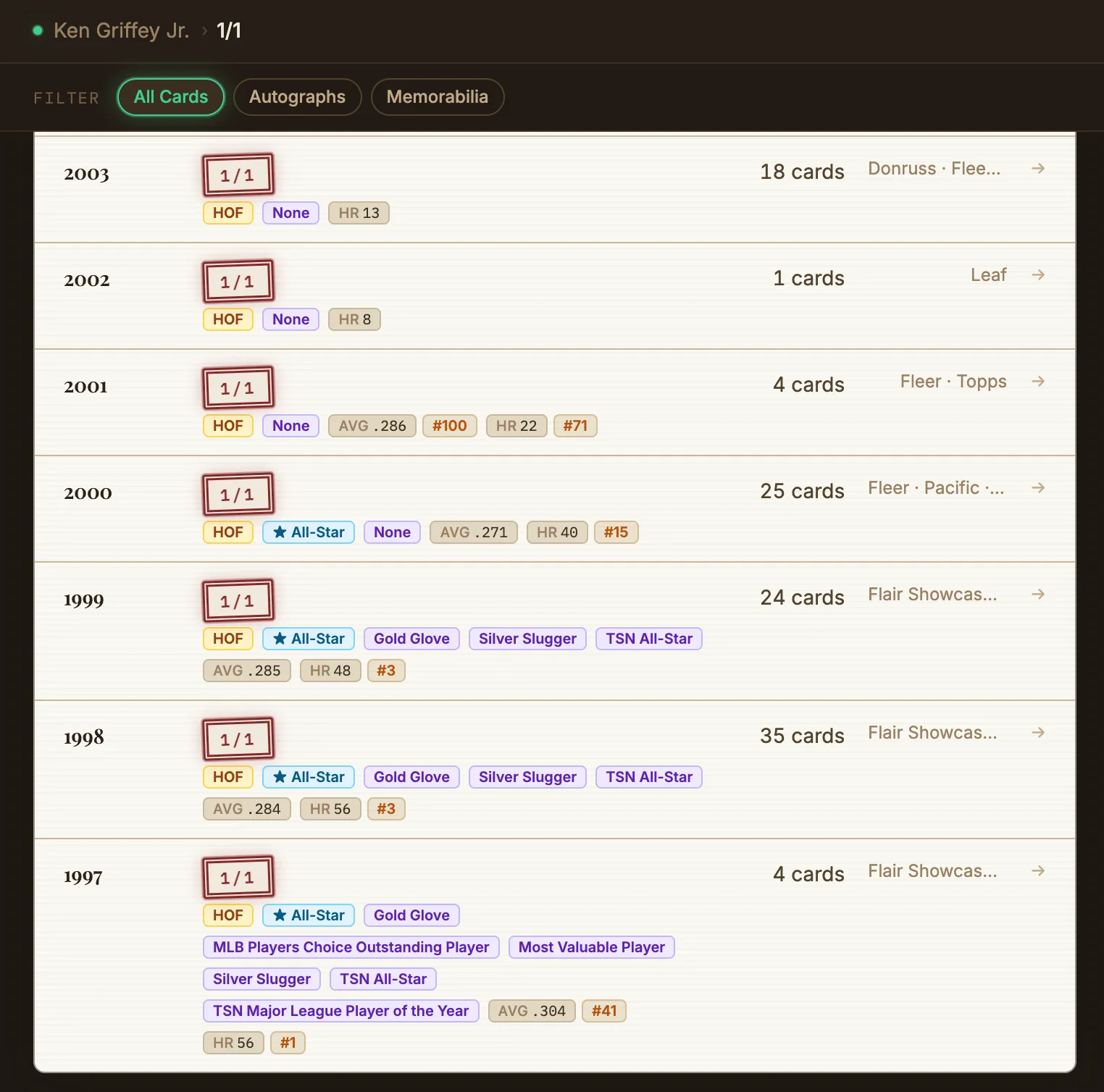
Your lineup, your budget
Name the players you actually collect and what you're willing to spend. Phorager keeps a shelf of what's available for each of them, priced where you live.
- Build a lineup of the players you follow, and pick your club from all 30 MLB teams.
- Set one number — max price per card — and every shelf respects it.
- Each player breaks into the phases of his card career: Pre-Rookie, Rookie, Active Career, Autograph, and Memorabilia.
- Listings carry auction-or-buy-it-now, grading company and grade, and refractor flags before you click through.
- Coming soon: recommendations that learn from your lineup, your favorites, and your budget — surfacing cards you'd want but wouldn't have thought to search for.
Most marketplaces make you go looking. This runs the other way round: tell Phorager who you collect and what you’ll spend, and the cards that fit come to you.
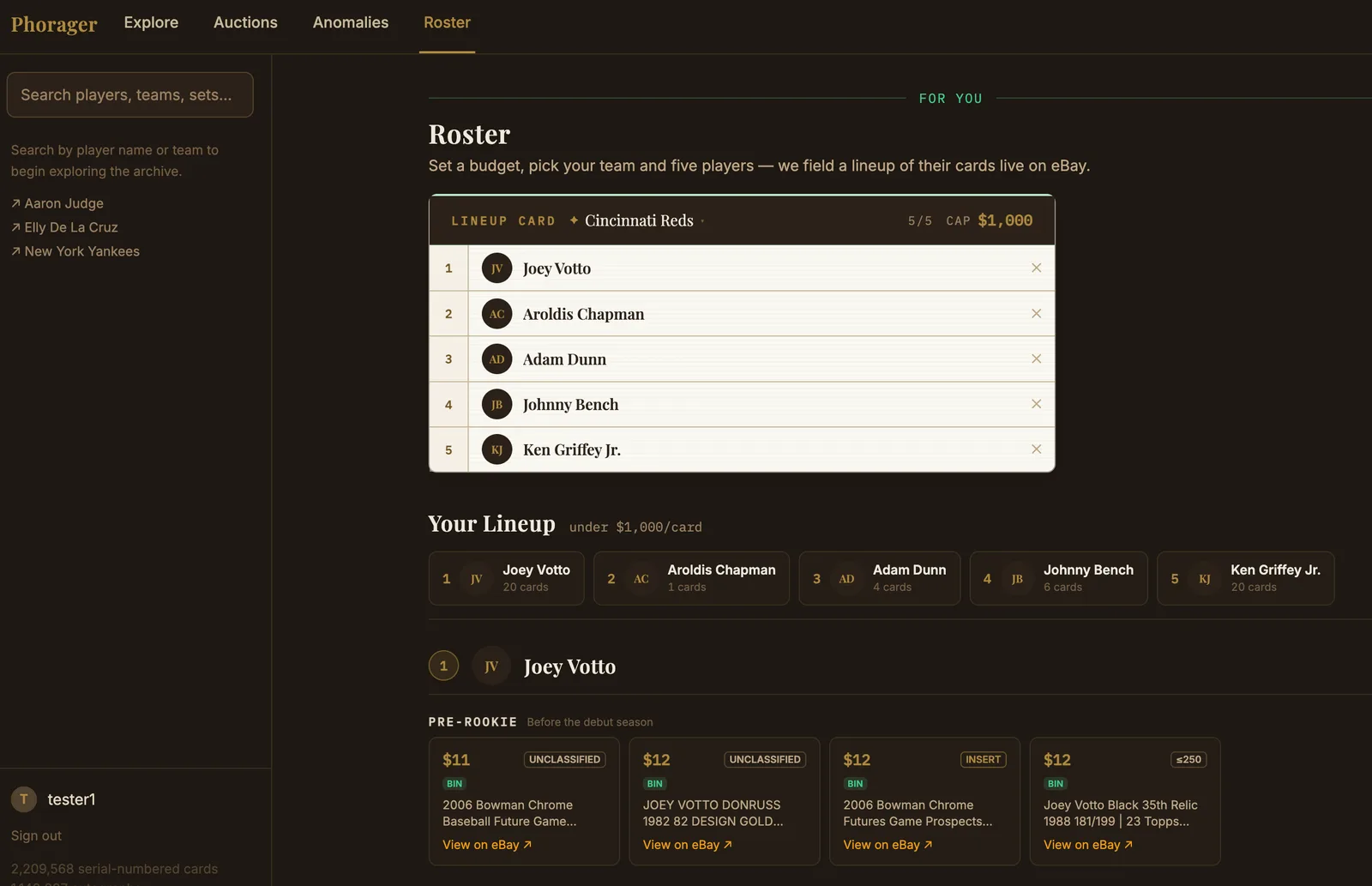
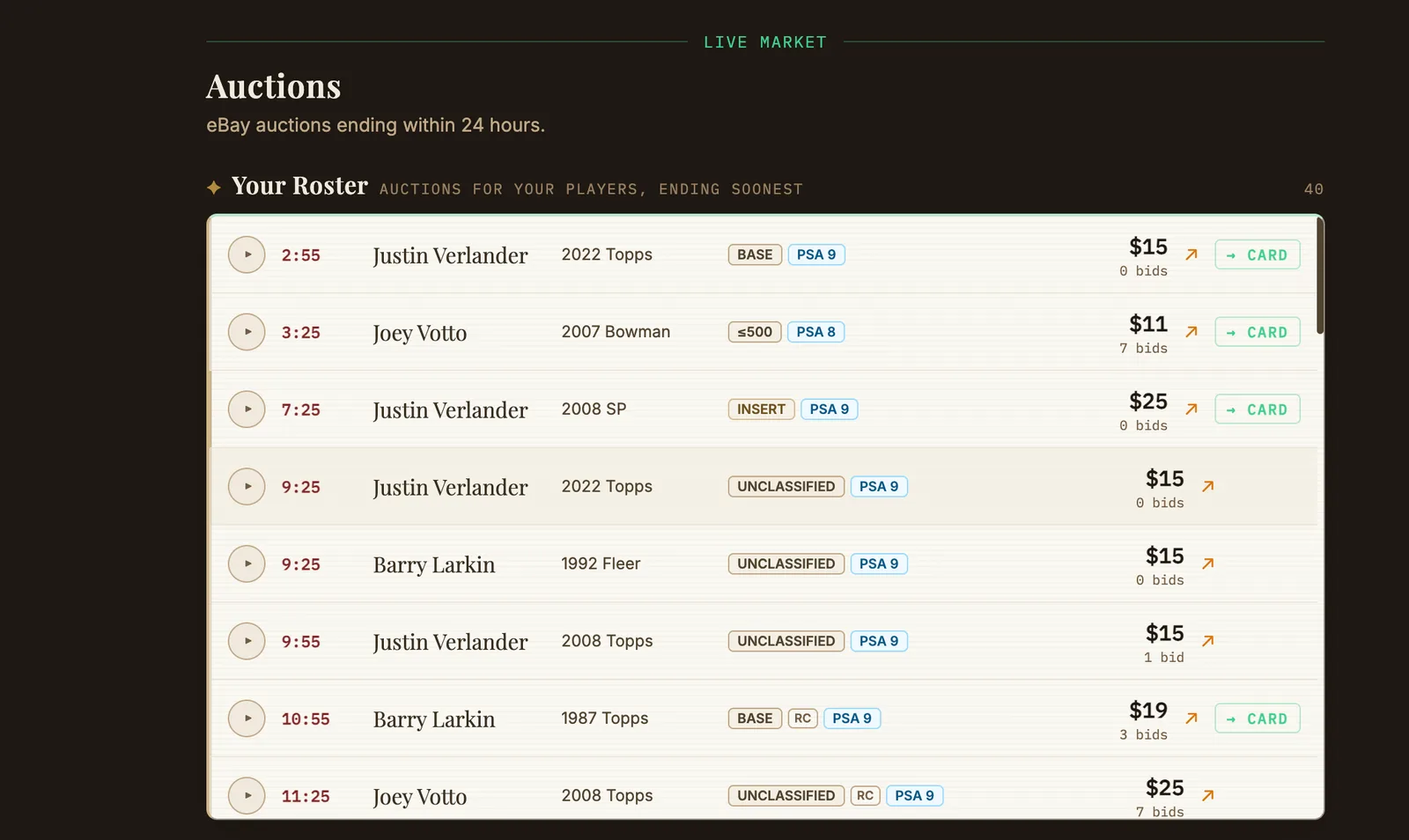
Everything ending in the next 24 hours
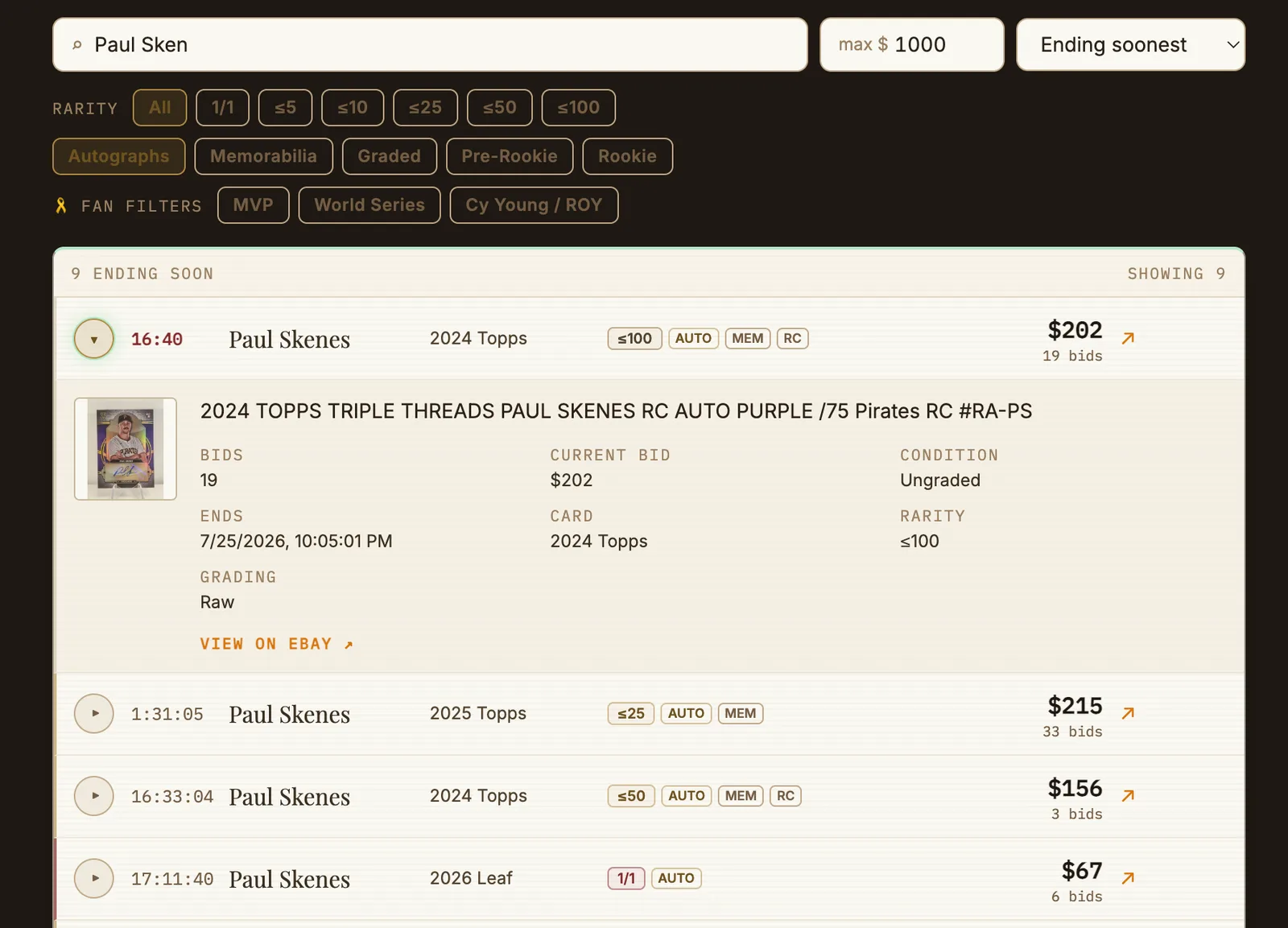
A live board of eBay baseball card auctions closing today, filtered the way a collector actually thinks about them.
- Per-second countdowns that turn red inside the final hour.
- Filter by Autographs, Memorabilia, Graded, Pre-Rookie, and Rookie — then narrow further with fan filters for MVP, World Series, and Cy Young or Rookie of the Year seasons.
- Sort by ending soonest or by price, and cap the board at whatever you set as your budget.
- A pinned strip up top surfaces auctions for the players already on your watchlist.
- Any listing matched to the catalog gets a jump link straight into that player's set in Explore.
Rare compared to who, exactly?
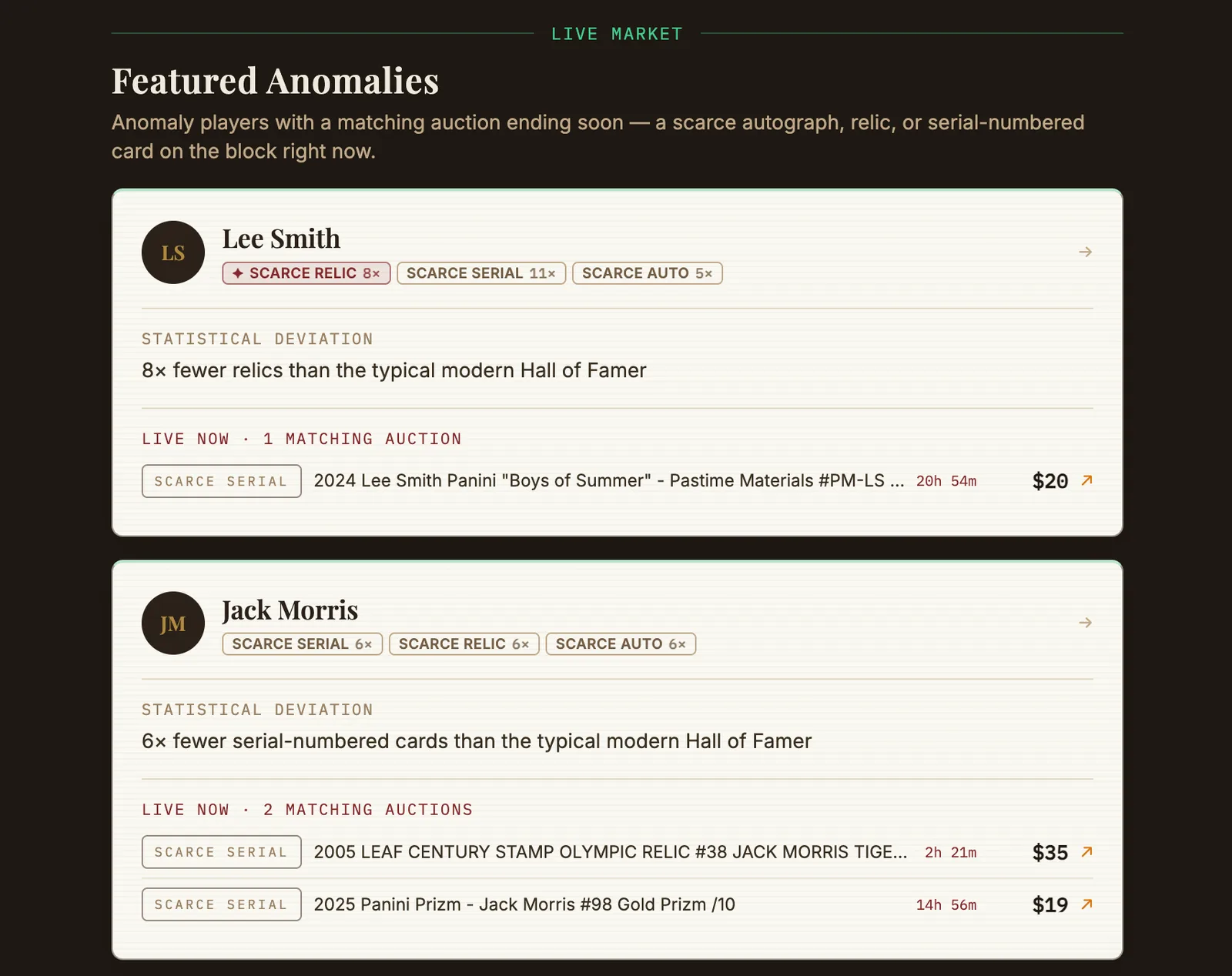
Scarcity is meaningless on its own. Phorager measures every player inside his own cohort — his era and his standing in the game — and flags the ones whose supply doesn't fit the company he keeps.
- Modern
- Hall of Famer
- Autographs
One of fourteen cohorts. Era splits at 1993, when certified autographs began — so a career that reached it is never measured against one that ended before it. Standing is Hall of Famer or All-Star. Attributes are autographs, rookies, relics, and serial-numbered cards.
- A player is ranked only against his own cohort — a modern Hall of Famer is never judged against a vintage All-Star, or against the market at large.
- The headline names the comparison outright: "62× fewer autographs than the typical modern Hall of Famer."
- Bottom 10% of his cohort puts a player in the feed. Bottom 5% marks his live listings wherever they appear.
- Flagged on two or more attributes and he's called out as a standout — corroboration, not one odd metric.
- Print-run scarcity only counts when at least half his cards have a documented run, so unnumbered inserts can't fake it.
Take Jeff Kent. Seventeen years, straight through the peak of serialization, and he enters the Hall of Fame with three serial-numbered autograph designs to his name — thirty physical copies. (A run of unnumbered auto inserts exists alongside them, with no print runs ever published.)
Held up against the card market at large, three is just a number. Held up against every other modern Hall of Famer, it’s the floor. That’s the whole idea: rare is a comparison, and the comparison is the part Phorager actually computes.
Buy It Now, docked to whatever you're reading
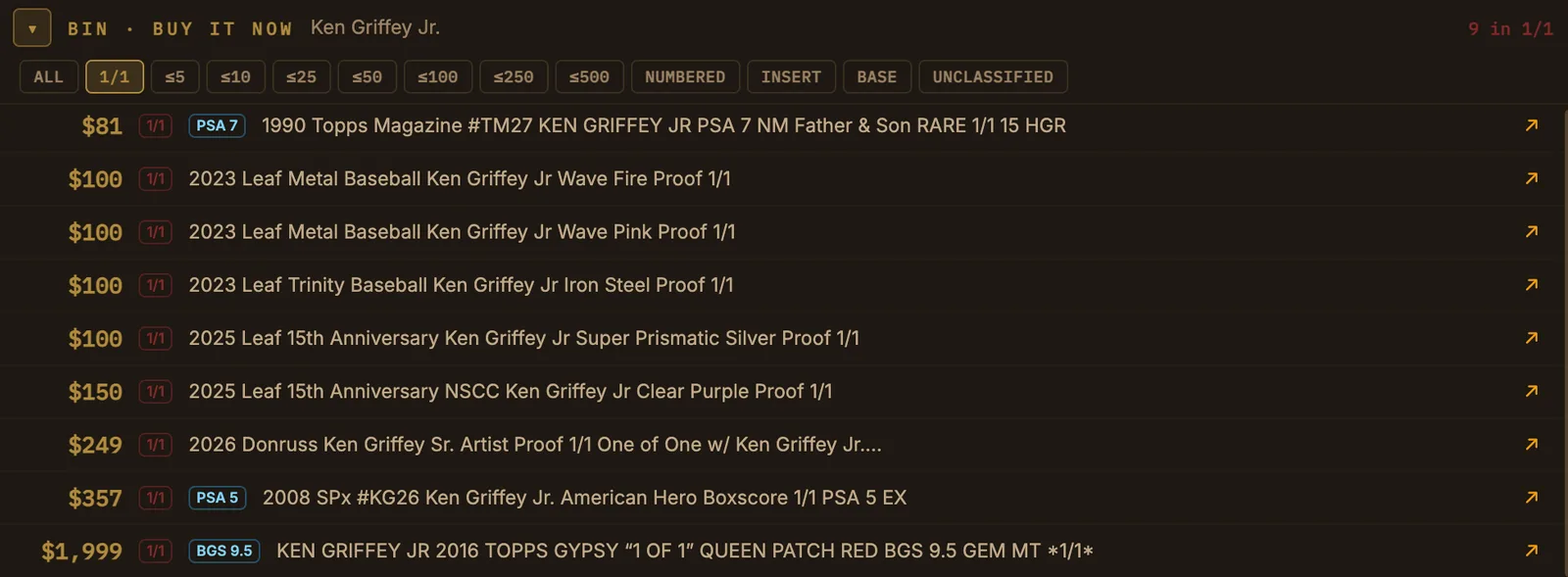
A console pinned to the bottom of every player workspace showing what is actually available right now — and it follows your drill.
- Select a rarity band in the panel above and the console filters itself to match.
- Drill into a single year and it narrows again, without a second search.
- Band chip, grading company and grade, and anomaly flags on every row, with a direct link out to the listing.
- Unfiltered, it samples the full spread of what is listed rather than only the cheapest few.
- Stays out of the way — it collapses, and it hides entirely for players with nothing listed.
Where the scarce ones surface
The cards you'd actually frame almost never come up for sale. When one surfaces — anywhere — it gets logged here.
- eBay appearances are logged automatically as they happen.
- Collectors add leads from Reddit, so cards that surface in the community don't vanish into a thread.
- Up and down votes with running tallies keep good leads near the top.
- On any card in those four tiers, the same feed appears inline — no separate search.
The rarest cards spend years invisible. A /5 might change hands twice a decade, and when it does the only trace is a listing that expires or a Reddit post that scrolls away. Sightings keeps that record, so the next collector chasing the same card has somewhere to start instead of nothing at all.
Screenshot coming
Also in the app
The rest of the archive
The card itself, and the ones you keep
Every card carries its full identity — and the ones worth remembering stay saved.
- — Year, brand, card number, print run, series, parent set, and attribute tags on every card.
- — Favorite a card or a whole set to keep it, then find it all again in one place.
- — Prebuilt COMC, eBay, and Google searches assembled from the card's own attributes.
- — One budget, set once, honored across Roster and Auctions.
A franchise, a season, a roster
Collect the club, not just the player. Work a franchise the same way — rarity first, then seasons, then the men who wore it.
- — Team rarity breakdown, then a year table of cards, players, and brands, then the roster itself.
- — Player rows show rarest tier reached, total cards, and 1/1 count.
- — Curated featured teams and World Series champion seasons as entry points.
- — Real season rosters with batting and pitching lines, every name opening that player's archive.
Start from the baseball
Sometimes you don't know which card you want yet — you just know who's worth watching this season, or who's finally going into Cooperstown.
- — Current-season leaderboards for batting average and ERA.
- — A Hall of Fame grid ranked by how deep each inductee's catalog actually runs.
- — Award-winning seasons — MVP, Cy Young, Rookie of the Year, Triple Crown.
What we track
2,158,222
Serial-Numbered Card Designs
across MLB player catalogs
1,094,622
Autographs Tracked
linked to verified player records
411.5M
Total Numbered Supply
cumulative career-level physical cards
Invite-only · Alpha
Join the Waitlist
We're onboarding collectors in small waves to keep the data sharp and the feedback close. Request an invite and we'll reach out when your seat opens.